On this page
We ran controlled tests across real AI search queries, same topic, different structures. Here’s what got content selected as an answer.
WHAT IS AEO?
Answer Engine Optimization (AEO) is optimizing your content to be selected as a direct answer by AI engines like ChatGPT, Perplexity, and Google AI Overviews not just ranked in search results.
The shift nobody planned for
We noticed it gradually: pages still indexed, keywords still in place but clicks dropping. When we ran the same queries through AI systems, the pattern was clear:
- Fewer links being surfaced
- More direct, synthesized answers
- Clear preference for confident, structured content
AI engines don’t return a ranked list. They return one answer. The content that gets chosen is structured, direct, and confident. Everything else gets ignored.
“Why would an AI choose this as the answer?” - once you ask that, everything about content strategy changes.
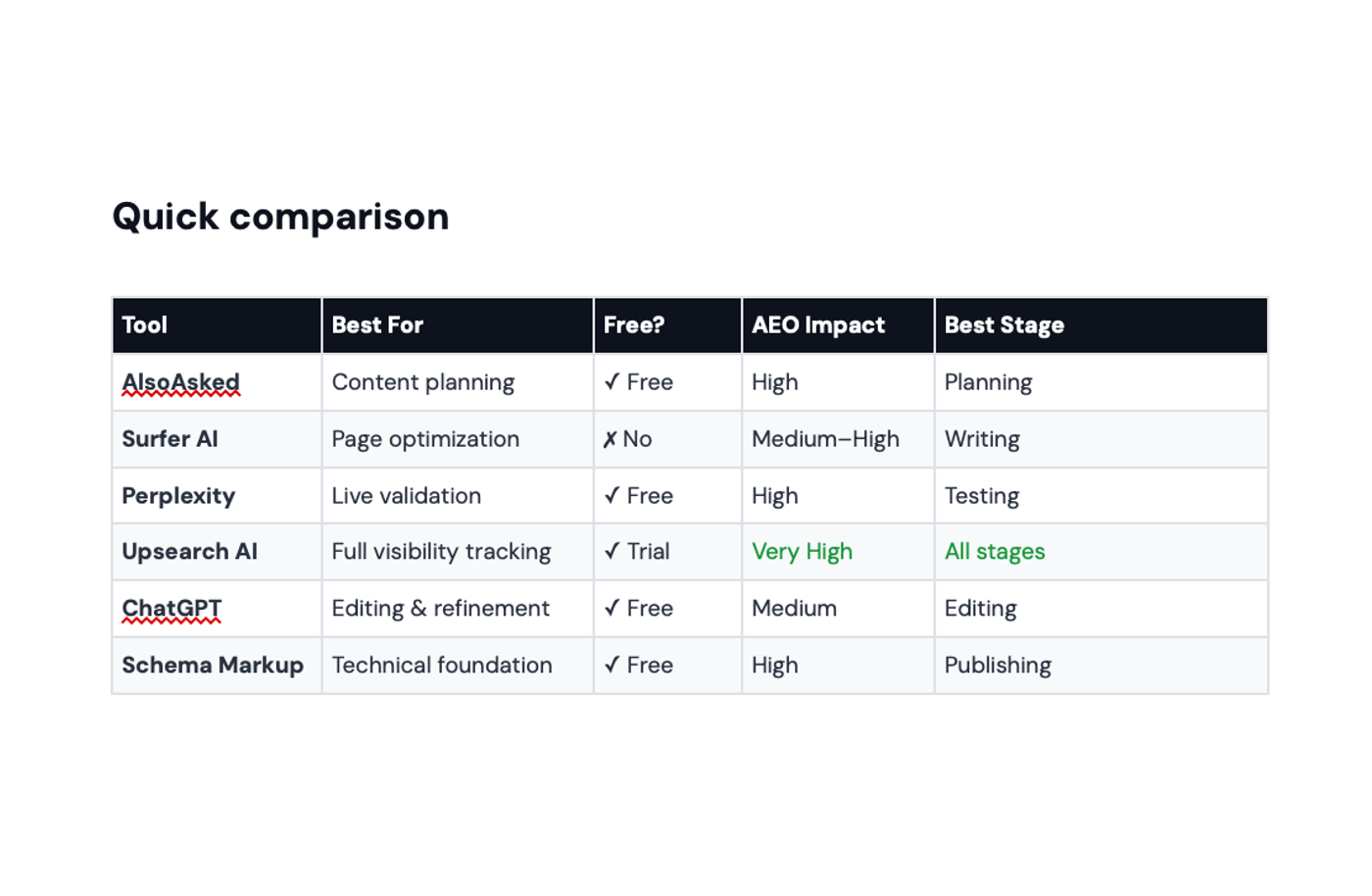
2026 AEO Tool Comparison: At a Glance
To help you choose the right infrastructure for your AI visibility, we’ve categorized our tested tools based on their primary impact, cost, and the specific stage of the content lifecycle they support.
1. AlsoAsked: The Planning Powerhouse
- Best For: Deep content planning and mapping user intent.
- Free Option: Yes (Freemium).
- AEO Impact: High.
- Best Stage: Initial Planning.
- The Breakdown: While traditional tools focus on keywords, AlsoAsked maps the "question chains" that AI engines use to synthesize answers.
2. Surfer AI: The Optimization Specialist
- Best For: Advanced page-level optimization and semantic coverage.
- Free Option: No (Paid).
- AEO Impact: Medium–High.
- Best Stage: Writing and Content Refinement.
- The Breakdown: It ensures your content covers the full conceptual space of a topic, making it a "trustworthy" source for LLMs.
3. Perplexity: The Reality Check
- Best For: Live validation and citation testing.
- Free Option: Yes (Freemium).
- AEO Impact: High.
- Best Stage: Testing and Post-Publishing.
- The Breakdown: The most honest way to see if your content actually gets cited in a real-world AI search environment.
4. Upsearch AI: The Strategy Command Center
- Best For: Full visibility tracking across all major LLMs and competitor benchmarking.
- Free Option: Yes (Free Trial).
- AEO Impact: Very High.
- Best Stage: All Stages (Continuous Monitoring).
- The Breakdown: Upsearch goes beyond data—it provides actionable "next steps" by tracking brand mentions across ChatGPT, Claude, Gemini, and more.
5. ChatGPT: The Clarity Stress-Test
- Best For: Editing, refinement, and removing "hedged" language.
- Free Option: Yes (Freemium).
- AEO Impact: Medium.
- Best Stage: Final Editing.
- The Breakdown: Use it to see if an AI can extract a clean answer from your draft before you hit publish.
6. Schema Markup: The Technical Bedrock
- Best For: Building a machine-readable technical foundation.
- Free Option: Yes (Free).
- AEO Impact: High.
- Best Stage: Publishing/Technical Setup.
- The Breakdown: Essential infrastructure (FAQ, HowTo) that signals your content’s structure directly to AI crawlers.
The idea here can be looks like this
You can click the links and it will open the one of the above.
- “I don’t know what questions my audience is asking” → AlsoAsked
- “My content exists but AI engines don’t cite it” → Surfer AI + Perplexity
- “I can’t tell if my AEO efforts are working” → Upsearch AI
- “I need to know what AI says about my brand vs competitors” → Upsearch AI
What Actually Worked: The DNA of High-Citation Content
1. Singularity of Intent
"Focus on answering one specific user intent per section to ensure AI engines recognize your content as a definitive, standalone answer."
2. The "3-Sentence" Rule
"Deliver your core answer within the first three sentences to satisfy the AI’s preference for immediate, fluff-free information."
3. Radical Confidence
"Eliminate vague or hesitant language in favor of a direct, authoritative tone that AI models can trust and cite with confidence."
Newsletter
Get the next AI search signal in your inbox.
Short, useful updates on AI visibility, citations, prompts, and category positioning.
No spam, unsubscribe anytime. See our privacy policy.
Related reading
Masterclass in AI search
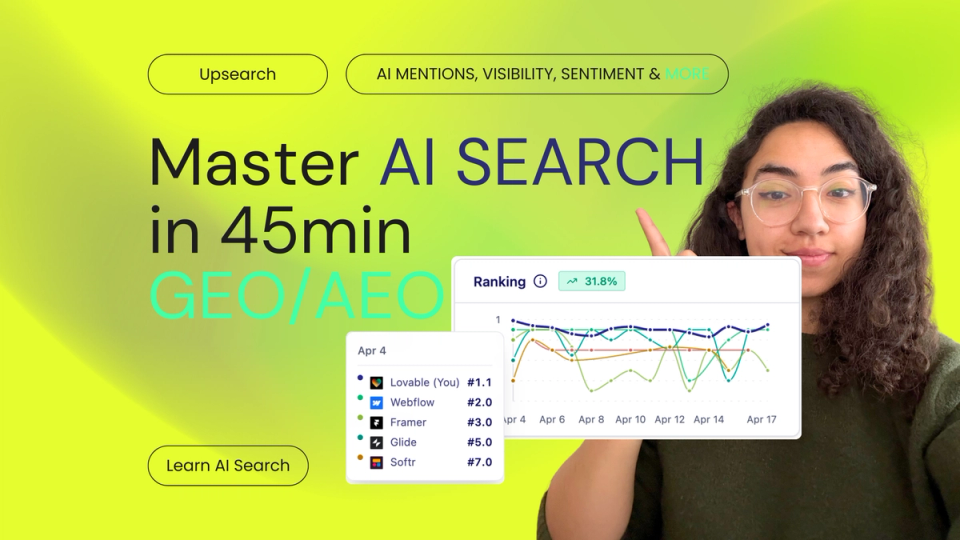
A video-based guide to advanced AI search optimization concepts.
The New SEO You Can't Afford to Ignore
The era of the blue link is giving way to the age of AI synthesis. Discover the architectural foundations of generative engine optimization and learn how to optimize your business for ChatGPT, Claude, and Gemini with Upsearch.
The Metric That Will Define Marketing in 2026
In 2026, blue search links are taking a backseat to generative engine answers. Here is how advanced AI brand visibility tracking helps your business dominate the conversational web without relying on short-lived hacks.
From insight to execution
Track how AI engines actually describe your brand.
Upsearch helps teams monitor prompt visibility, competitive positioning, and citations across the answer engines that now shape real buying journeys.