On this page
- Introduction
- How LLMs Choose Sources
- Tier One Authority Building
- Tier Two Authority Signals
- Authority Graph Theory
- Schema Implementation Strategy
- The Knowledge Graph and Entity Optimization
- Creating Citation-Worthy Content
- Structure for Machine Reading
- High Extraction Content Types
- Writing for Extraction
- Building Consistent Entity Presence
- Expert Entity Building
- Technical Crawler Optimization
- Performance Optimization
- Content Freshness Signals
- Content Licensing Strategy
- AI Attribution Modeling
- Closing
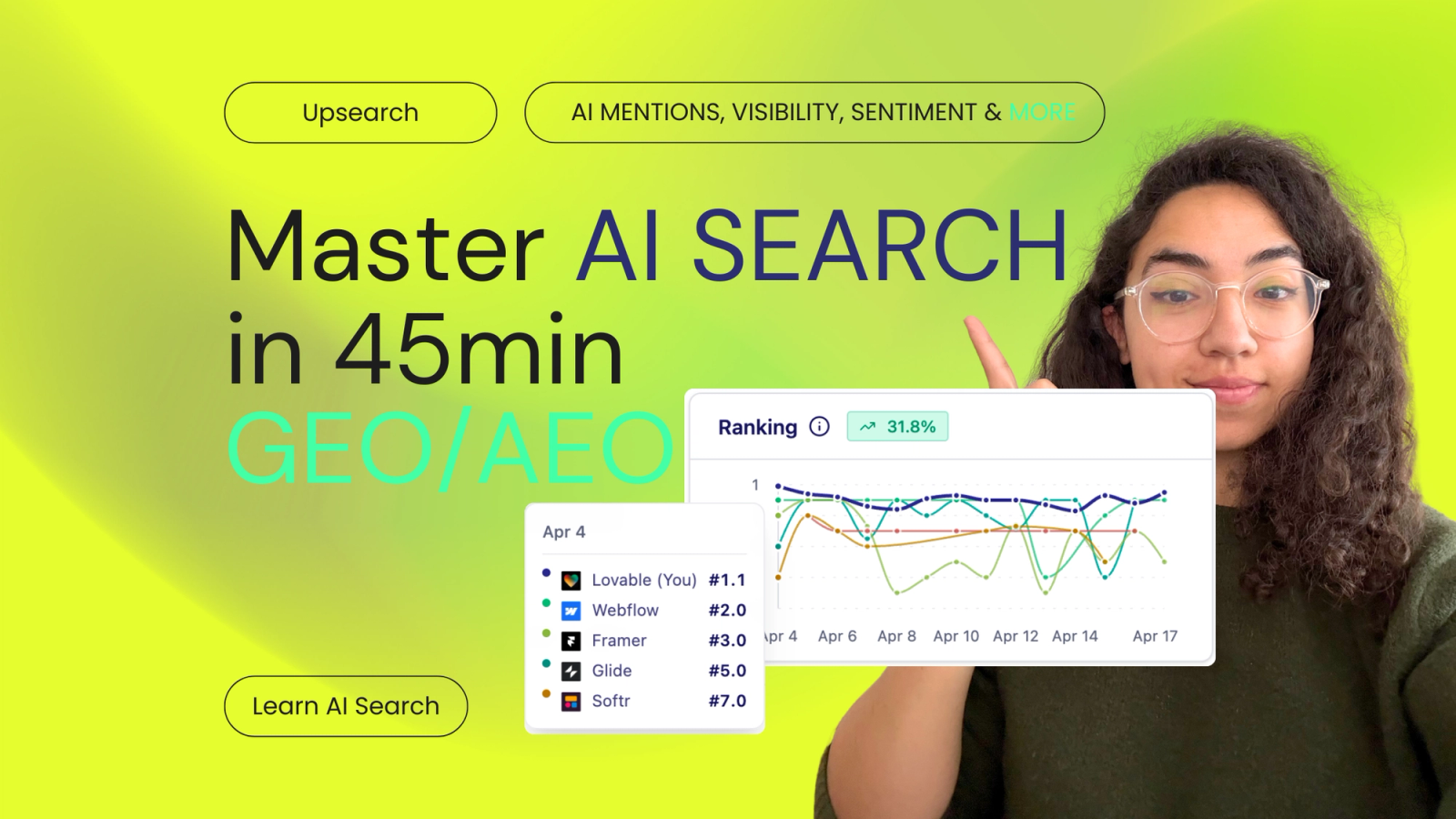
To master AI search we made this video where you can get really advanced in AI search:
<iframe width="560" height="315" src="https://www.youtube.com/embed/pQGbyOGtcAU?si=09WT8j5XrLMQs8CK" title="YouTube video player" frameborder="0" allow="accelerometer; autoplay; clipboard-write; encrypted-media; gyroscope; picture-in-picture; web-share" referrerpolicy="strict-origin-when-cross-origin" allowfullscreen></iframe>
Here's the transcript so you can follow:
This is the full transcript of the video "Mastering AI Search Optimization in 45min" by Eya Beldi, CMO of Upsearch.
Introduction
Hi, I'm Eya, an expert marketer and recently, by recently I mean the last three years, I've grown really passionate about AI search and trying to understand everything about it. And now I want to explain to all marketers, people who understand SEO, what AI search is and how they can get really advanced with it. So if you know a little bit about it, if you know a little bit about SEO, in the next 45 minutes, you're gonna master AI search. Let's get started.
Mastering your generative engine optimization, or as some people call it, answer engine optimization strategy. Others also call it AI SEO, or just AI search. So these are the topics that we're going to cover today: how LLMs choose sources, tier one authority building, tier two authority signals, authority graph theory, schema implementation strategy. It's going to get a bit technical, but it will make you a great AI search expert by the end. The brain behind AI entities and the knowledge graph, creating citation-worthy content, structure for machine reading, and high extraction content types. We're also going to learn how to write for extraction, build consistent entity presence, understand expert entity building, and technical crawler optimization. We're even going to go deeper with performance optimization, content freshness signals, content licensing strategy, and AI attribution modeling.
How LLMs Choose Sources
So how do LLMs choose sources? Well, understanding how LLMs really choose their sources is like AI SEO 101. It's GEO 101, basically. And like Google's algorithm, which we've spent a whole lifetime working on, this is a bit different because LLM source selection follows a different set of rules.
First, the training data. Most LLMs are trained on Common Crawl, which over-indexes high authority domains, basically the same way as Google's domain authority algorithm. But here there are other sources that have more importance, and we're going to talk about them. They're called tier one authority and tier two.
Wikipedia is one of those tier one authority sources. It's why tech companies pay heavily to have Wikipedia presences. Educational institutions, government sites, and major news outlets are also super important here because they're a bit harder to manipulate.
LLMs also learn from citation patterns. So if your content gets cited by sources that get cited, you move up the authority chain. It's like PageRank, but for factual authority. Structure also matters enormously here. LLMs cannot interpret your content the way humans can. If your information isn't in a format they can parse and extract, you're invisible, regardless of the quality of what you're writing. And unlike traditional SEO, where old content can rank forever, LLMs have a recency bias built in. They're trained to prioritize recent information, especially for topics that change frequently.
The formula I show here is unofficial because OpenAI and Anthropic don't really publish their exact algorithms, but from extensive testing, these are the four factors consistently determining citation probability. The thing you can use to know for your own domain what gets cited is a tool like Upsearch. With Upsearch, if you go to the dashboard, you can see something called top cited domains. It tells you the highest-cited pages for any brand. You can also see the three big sources that AI consistently cites: Reddit, Wikipedia, and LinkedIn. You can check this for yourself or for competitors. You get a visibility score that covers rankings, sentiment, and mention rate, and you can compare it directly against competitors and see which LLMs were used.
Tier One Authority Building
Basically, what are the main sources? Wikipedia gets 1.7 billion unique visitors monthly, but more importantly, it's currently cited in 85% of AI training datasets. So when an LLM needs to verify a fact about a company, a person, or a concept, Wikipedia is often the first source to check. But you can't just create a Wikipedia page tomorrow. Your boss might be asking that. Wikipedia has really strict notability guidelines. You need significant coverage in independent and reliable sources to even be considered. So the long-term strategy is basically to try to get covered in sources that Wikipedia considers reliable, then work with Wikipedia editors. I don't recommend paying for Wikipedia editors unless you just need a one-off. But if you're an agency, you might even consider having someone on your team become a Wikipedia editor themselves. That way you understand the guidelines very well, you can benefit the community, and build profiles for your clients.
Academic citation is also part of tier one authority building. It's partly because of how hard it is to publish academic papers. Not everyone can just do it. But there are workarounds, because every executive and subject matter expert in your organization should have a Google Scholar profile. You can also partner with universities for research studies or publish in industry journals. When an LLM sees you get cited in an academic context, your authority score just skyrockets. So why not do it?
Major news outlets and government databases are also part of tier one authority building because they're harder to manipulate, which is exactly why they matter. Focus on earning legitimate coverage through newsworthy announcements, expert commentary, and industry leadership. If you're in a regulated industry, ensure your regulatory filings are complete and accessible so LLMs can access them too.
Tier Two Authority Signals
The things that go into tier two authority signals are important. Not as important as tier one, but still highly valuable. These are the sources that LLMs check for specific types of queries.
Industry databases like Crunchbase are structured gold mines, basically. When someone asks an LLM what a company does or how much funding they raised, Crunchbase is often the source. So make sure you keep those profiles meticulously updated. Treat them like a second website if necessary. The same goes for review platforms in your category.
LinkedIn deserves its own special moment here. It's increasingly being used as a primary source by LLMs, especially for company information and now for queries. So your LinkedIn company page should be treated as a primary authority-building asset. Not just, "oh, we have a LinkedIn page, we post once a week." No, it should be keyword rich, it should have a complete description, it should show your expertise. Every time you update it, make sure LLMs will parse it. And this goes the same way for personal LinkedIn. If you start sharing articles or posts on your own LinkedIn, LLMs parse those too now. Make sure they're updated and prompt-rich. And if you don't know which prompts you should optimize for, you can also use Upsearch for that. It can generate prompts according to your personas, creating well-targeted, well-researched prompts for all the different people in your audience.
Trade publications are also an opportunity to build topical authority. Don't just advertise on those. Really contribute with actual expertise. Byline articles, expert quotes, and speaking appearances all contribute to the authority graph. LLMs are trained to recognize industry experts, and frequent appearances in trade publications signal expertise. A tactical tip here: create a mentions database tracking every time your company or executives are mentioned in any publication. This helps you understand your authority footprint and identify gaps where you need to optimize.
Authority Graph Theory
This is where it gets really sophisticated, but you need to understand it. Because LLMs don't just look at individual sources, they look at relationship patterns. That's what we call the authority graph, because it's like patterns all linked to each other.
When an LLM is trained, it sees patterns of co-citations. So if your brand consistently appears in content alongside recognized leaders, the model begins to associate it with that level of authority. Here's an example: there is a brand of phones called Haibriq that makes e-ink phones. They're usually not mentioned next to Apple because Apple users don't buy those kinds of phones. But if they start getting mentioned alongside Apple, Samsung, and those big names, AIs would begin to treat them as industry leaders and mention them alongside those authorities. So being mentioned in a top 10 list with established players is still super valuable, even if you're ranking number 10. It's the relationship and co-citation that matter.
Citation chains are also very powerful. Let's say TechCrunch cites a report from Gartner, and Gartner's report cites your company's research. You've now built a citation chain to TechCrunch through Gartner, and LLMs pick up on these chains. So if you're doing PR outreach, don't just pitch your story. Pitch stories that position you alongside or in context with established authorities. "How companies X and Y are approaching a problem differently" is way more valuable than "company X launches product."
Schema Implementation Strategy
Now that you know how these patterns work, you need to understand how to implement the technical details on your website. And we start with the most important thing, which is schema implementation. Without it, you're making LLMs guess what your content means.
LLMs prefer to use as few resources as possible when going through your content. So once you make it easy for them with schema markups, they will understand better, easier, with less computation. JSON-LD is the format you want to use. It's the preferred parsing language for LLMs. There are other types called microdata and RDFa. They work, but JSON-LD is just cleaner.
The schema types that are super important:
Organization schema is the foundation. You need to have it, and it needs to be completely filled out. Include the logo, social media profiles, founders, founding date, contact information, addresses, everything. This builds your entity profile.
Article schema is also important. Make sure you're including author information with links to their person schema, publisher information, and most importantly, date modified, because LLMs check this to determine content freshness. Content freshness is one of the most important factors in getting cited by AI.
FAQ schema is pure gold for AI extraction. When you mark up Q&A content with FAQ schema, you're essentially pre-formatting content for how LLMs want to cite it. We've seen that FAQ schema content gets cited three times more frequently than equivalent unstructured content. So just use it.
HowTo schema works the same way for procedural content. If you're explaining a process, this makes it trivial for LLMs to extract and cite your steps.
Person schema is needed for all the important people in your company, or even anyone with some kind of expertise. It builds individual authority. When someone asks about your CEO or chief scientist, a proper person schema helps ensure accurate information and helps avoid hallucination.
Make sure after building any schema to validate everything using schema.org's validator or Google's Rich Results Test. Broken schema is sometimes worse than no schema. It signals poor implementation and can make AI hallucinate. And we don't want that.
The Knowledge Graph and Entity Optimization
Knowledge graph optimization is about making sure AI systems know exactly who you are and don't confuse you with anyone else. Wikidata is the backbone of this. If you're not familiar, Wikidata is the structured data counterpart to Wikipedia. It's a massive database of entities and their relationships. Getting a Wikidata entry, I think it's called a QID, for your organization is important because you can reference it in your schema markups. This creates an important link between your website and your recognized entity.
Then there are type declarations. You have to add them in your schema because it tells LLMs what kind of entity you are. Are you a corporate business? A local business? An educational organization? Be specific, because it helps them.
SameAs properties are how you link all your profiles together. In your organization schema, include SameAs links to your LinkedIn, Crunchbase, Wikipedia, and any other authoritative profile you have. This helps LLMs understand that all of these profiles represent the same entity.
Consistency in naming is more important than most people realize. If you're called "Company Inc." on your website but "Company Incorporated" on LinkedIn and just "Company" on Crunchbase, you're creating entity confusion. Just pick one canonical name and use it everywhere. I know AI should be smarter than this by now, but unfortunately it's not. So just pick one.
Google's Knowledge Graph API actually lets you monitor how Google understands your entity. If you're showing up with wrong information or missing key facts, that's a signal your Knowledge Graph optimization needs work.
Creating Citation-Worthy Content
Now let's look at how to create citation-worthy content. What kind of content can you write that AI deems worthy of citing? AI systems are tired of being called out for hallucinating, so now they do a lot of validation. This is where it changes a lot from traditional SEO, because AI-optimized content is optimized for extraction, while traditional SEO is built for humans and Google's algorithm. Now we're in a period where we need to create content that serves machines, people, and Google's algorithm. Three things to consider simultaneously.
There's something called atomic content units. These are statements that can stand alone and be extracted and cited without needing surrounding context. They're self-contained packets of information. For example: "we're growing really fast" is absolutely useless to an LLM. It's subjective, vague, and impossible to verify. But "our customer base grew from 1,200 to 4,800 in Q3 2024, a 300% increase year-over-year" is perfect. It has a specific number, a time frame, comparative data, and it shows the methodology.
The formula for a citation-worthy claim is: a specific data point or fact, a temporal marker (when is this true?), attribution or source (where did this come from?), and context that makes this meaningful. Aim for three to five of these per 500 words. More than that, you're probably diluting your content. Less than that, and you're not giving LLMs enough to work with.
Even if you're mentioning your own sources, just say "according to internal data" or "based on a survey of 500 customers conducted in November 2025." This gives LLMs confidence to cite you. They're less likely to cite unsourced claims because they don't want to be called hallucinators again.
Use consistent terminology. If you call something "machine learning" in one paragraph, "ML" in another, and "artificial intelligence" in a third, you're making extraction harder. Pick the terms you want to be known for and use them consistently.
Structure for Machine Reading
What kind of structure do you need for AIs to read your content easily? Semantic HTML is having a comeback. We had this conversation in the 2000s, and now it's having a renaissance because of AI. For years, I got lazy with divs and spans for everything. But purposeful markup directly impacts how LLMs understand content. So I'm not lazy with it anymore.
The article element tells LLMs this is a distinct piece of content worth considering. Always wrap your main content in article tags. Heading hierarchy is also very important. The most critical thing here is structure and topic hierarchy. If you skip from H1 to H3 or use headings for styling instead of structure, you're breaking their ability to parse your content. Every page should have exactly one H1, followed by H2s for main sections and H3s for subsections. Never skip levels.
The time element with the datetime attribute is huge for temporal grounding. When you mention a date, wrap it in a time tag with a machine-readable datetime attribute. This helps LLMs understand when information is from and judge its relevance. Blockquotes with cite attributes are how you properly mark up quotes and attributions. If you're quoting research, an expert, or another source, use these tags. LLMs respect proper attribution and are more likely to cite content that demonstrates it.
And if you think this is all too hard and you just want steps to improve your AI visibility without learning all of this, you can go to Upsearch and use the strategy report feature. It generates a prioritized action plan for exactly what to do to improve your AI search visibility.
High Extraction Content Types
Let's talk about high extraction content types. What are AI's favorites? Because yes, there are favorites. Through extensive testing, these five content formats consistently outperform others for AI citation.
Comparison tables are catnip for LLMs. When someone asks what's the difference between X and Y, LLMs look for comparison content. Tables make this trivial to extract. The key is including actual data points, not just "product A is better." Use specifics like "product A processes 10,000 requests per second versus product B's 5,000." Include dates to show when the comparison was accurate and cite your sources.
Statistical content is highly citation-worthy because it's verifiable and specific. But here's what most people miss: you need to include methodology. Don't just say "80% of marketers use AI." Say "80% of B2B marketers surveyed, n=500, conducted October 2024, report using AI tools weekly." The methodology gives LLMs confidence to cite you.
Step-by-step processes with HowTo schema markup are perfect for instructional queries. The key is making each step standalone and actionable. Instead of "configure settings," say "navigate to Settings, click on API, click Create New Key, and copy the generated token." That's specific enough to get cited.
Expert quotes boost authority by association, but they need full attribution. "John Smith, CDO of TechCorp, stated in an October 2023 interview" gives LLMs everything they need. Vague quotes like "industry experts say" are worthless. Don't use them.
Glossaries and definition content serve a specific query type: "what is X?" These are some of the highest-volume AI queries. A well-structured glossary with clear term definitions becomes a go-to citation source. Use definition list HTML and consider adding definition schema.
Writing for Extraction
Now that you know what types of content to write, you need to know how to write it. Traditional SEO was about keeping people on the page and satisfying Google's algorithm. Now it's about making extraction as easy as possible. I know what I'm going to say next is going to be counterintuitive for many marketers, but it is what it is.
The inverted pyramid has been journalism's standard forever, but we need to take it a step further. The very first sentence of any piece of content should directly answer the primary question that your content addresses. Don't build up to it. Don't save the reveal. Lead with the answer.
Then immediately support that answer with evidence. If you claim something in sentence one, sentence two should back it up with data, a quote, or a source. Context and nuance come third. This is where you explain the why and how. But this comes after the extractable core.
Topic sentences are critical. Each paragraph should start with a sentence that could stand alone and still make sense. LLMs often extract just the first sentence of a paragraph. So if it starts with "additionally, this approach..." without context, it's uncitable.
Please, please, please avoid ambiguous pronouns. "It improved performance by 40%" is unusable. LLMs would have to parse the whole website to understand what "it" refers to, and they won't do that because it costs compute resources. Always use the actual noun: "the algorithm improved performance by 40%." That's extractable.
This is the hard part for traditional content marketers. If you're not optimizing for engagement time anymore, a user who gets their answer in the first sentence and leaves might feel like a failure. It actually isn't, because they got the answer. And sometimes you need it that way because people use it to double-check that an AI is not hallucinating. If you want LLMs to extract your content and cite it, even if the user never visits your site, leading with the answer is really, really important.
Also: every paragraph should contain one extractable idea. If you're trying to make three points in one paragraph, split them into three paragraphs. It makes extraction cleaner.
Building Consistent Entity Presence
Entity consolidation is about making absolutely certain that when an LLM encounters any mention of your organization anywhere, it knows it's all the same company. What we call NAP consistency: name, address, phone. It's a local SEO concept, but now it's even more critical. LLMs don't have sophisticated entity resolution. If your address is formatted differently across platforms, they might not be certain it's the same company. Pick one canonical format and use it everywhere. "123 Main Street, Suite 100, New York, NY 10001" everywhere, not "123 Main ST" in some places and "123 Main Street" in others. Include this in your organization schema on every page of your site, not just your homepage. Repetition reinforces the entity.
Schema relationships are also how you build your entity graph. In your organization schema, explicitly define relationships: who founded the company, who works there, what parent company you're part of if you have one. For employees, include their previous organizations using the alumniOf property, which builds authority by association.
Entity maintenance is ongoing work. I know it's a lot, but it's worth it. Put a quarterly calendar reminder to check your Wikidata entry for accuracy, Google your company name and check the knowledge panel, submit corrections through Google's feedback mechanism, and audit third-party directory listings like Crunchbase, LinkedIn, and relevant industry directories.
A tip that has really helped me: I have a document called a Canonical Entity Document that the entire team can reference directly. It has the official name, address formatting rules, founding date, founder names, and everything. When anyone updates any platform, they reference this document. It prevents confusion over time. And it also makes it very clear whose fault it is when something gets updated wrong.
Expert Entity Building
LLMs don't just evaluate organizational authority. They evaluate individual authority as well. When someone asks about a topic, LLMs often cite individual experts, not just companies. So every key executive, every subject matter expert, every thought leader in your organization should have a fully built-out digital authority profile.
Google Scholar is critical for any expert knowledge claims. Even if you're not in academia, you can still publish there. Make sure it's high quality. We don't need more AI-generated filler on the internet. Industry-wide papers, research studies, and even substantive blog posts can be added to Google Scholar if they're well written and substantial.
Track your h-index, which is a measure of publication impact. You need it to be machine-readable because it's another authority metric. You can also collaborate with others in your field, because co-authorship creates authority graphs between individuals.
Implement person schema for every expert on your company site. Create author pages that are fully structured with schema, including job titles, their connection to your organization, where they worked before using the alumniOf property, and SameAs links to their LinkedIn, professional website, and published work. Don't include their Instagram or TikTok. Nobody needs to see that, unless they're actively sharing company-related content, in which case it becomes valuable.
Speaking engagements are something most companies don't document, and they should. Have a page on your website listing conference keynotes and panel appearances with all the details, marked up with proper structured data. It gives LLMs concrete evidence of industry recognition. If your experts have won industry awards, document those too.
For LinkedIn specifically: that Featured section should showcase media appearances, published articles, keynote recordings, and regular post positions. And motivate your employees to publish on LinkedIn. When 50 employees are regularly sharing insights and engaging with industry content, it creates an authority halo effect for the organization. If you need to bribe your employees to do it, do it. Buy whoever posts the most something useful at the end of the month. Just do it.
Build a media quotes database too. Every time each expert is quoted anywhere, log it. This helps you pitch them for future opportunities and shows their quote-worthiness to journalists.
Technical Crawler Optimization
Before we get into the technical setup, you need to answer one important strategic question: do you want AI companies training on your content?
First, understand the crawlers. GPTBot is OpenAI's crawler for training ChatGPT. Google Extended is for Gemini training data and is separate from their search crawlers. CCBot powers Common Crawl, which many models train on. Anthropic uses both Anthropic AI and ClaudeBot for Claude. Your robots.txt file controls access to all of these.
The default position most companies should take is allowing these crawlers. Because blocking them means your content won't be in the training data, which means you won't get cited. You become invisible to AI. But there are valid reasons to block them: if you have proprietary content you're licensing separately, if you're in negotiation with AI companies for a direct partnership, if your content is behind a paywall and crawler access undermines your business model, or if you have bandwidth concerns from aggressive crawling.
A crawl delay is good common practice regardless. It tells crawlers to wait between requests so they can index your site over time without hammering your servers. Five seconds is reasonable. If you want a more sophisticated approach, you can allow trusted crawlers with selective access: allow access to your blog, but block premium research reports or whatever you consider your most valuable gated content. This gets you general visibility while protecting your most important assets.
Monitor your server logs to see which bots are hitting your website hardest. If you see abusive crawling patterns, you can block specific user agents. One important note: major AI crawlers generally respect robots.txt, but not all AI scrapers do. For truly sensitive content, robots.txt is not sufficient protection. You need proper authentication and access controls.
Performance Optimization
Site speed matters for AI crawlers in the same way it matters for traditional SEO. If your site takes too long to render, AI crawlers will time out and not use your content, because they're often operating on tighter compute budgets and simpler rendering engines than Google. If your site is slow, they'll just crawl fewer pages or skip it entirely.
Time to First Byte (TTFB): this is how long it takes your server to start responding to requests. If your TTFB is over 600 milliseconds, most AI crawlers will time out or move on. You need to optimize your server response time through better hosting, caching strategies, and database optimization.
Largest Contentful Paint (LCP) measures when your main content becomes visible. For AI crawlers, this is when they can start parsing your content. If your LCP is slow because you're loading heavy images or waiting on JavaScript, crawlers may not stay long enough to see your actual content.
JavaScript rendering is expensive for crawlers. If your content requires complex JavaScript execution to appear, many AI crawlers will miss it entirely, because they are not as sophisticated as Google's renderer. The solution is server-side rendering or static-site generation for critical content. Your marketing content should be in the HTML, not generated by JavaScript at render time.
CDNs reduce latency globally. If AI company crawlers are hitting your site from various global locations, a CDN ensures fast response times everywhere.
Mobile-first indexing applies to AI too. Many AI crawlers use mobile user agents. If your mobile site is different from or slower than your desktop site, that's what they're seeing. Mobile-first effectively means AI-first. Run regular Lighthouse audits and aim for a 90+ performance score. This isn't just about user experience; it also impacts how much of your content gets into the AI training database and gets cited.
Content Freshness Signals
Content freshness is more important for AI than traditional SEO. LLMs are trained to prefer recent information, especially for topics that change frequently.
The modified time meta tag tells systems when content was last updated. But don't just update this tag without actually updating the content. LLMs are getting smarter about detecting fake freshness signals. Update the date when you actually make meaningful changes.
In your article schema, always include dateModified in addition to datePublished. When you update an article, update this timestamp. Some LLMs specifically check for this as a recency signal.
Develop a content refresh schedule. I do this once a year to update yearly references and swap in newer citations and sources. Evergreen content should be reviewed regularly. Update statistics, refresh examples, add new developments, remove outdated information. Each refresh should be substantial enough to genuinely warrant updating the modified date.
Make freshness visible to users, not just machines. Adding "Last updated: November 4, 2024" at the top of articles serves two purposes: it signals freshness to human readers who want to know if they can trust the source, and it creates a parsable freshness indicator for LLMs.
Content Licensing Strategy
Content licensing is something I've added as its own section because I think it's genuinely important. I've been to conferences where the Economist and the Financial Times are actively debating whether to let AI crawl their websites or require AI companies to pay for access. There isn't one right answer. It really depends on your business model and goals. Just have a think about it and decide intentionally what you want to do with AI crawlers, rather than leaving your robots.txt on defaults without having considered it.
AI Attribution Modeling
Most AI citations don't result in trackable clicks. When ChatGPT tells someone about your company, they might research you later, but you really can't trace that visit back to the AI mention. Traditional attribution breaks down here.
What I would suggest is using a tracking tool like Upsearch to see your visibility score, mention rate, sentiment, and ranking position across LLMs. You can see how often you're getting cited by specific models: Copilot, Llama Chat, AI Overviews, AI Mode, Claude, Perplexity, ChatGPT. You can click on a specific prompt to check by LLM which one is ranking, which one is citing you, and what the sentiment is for each response.
Closing
I hope this helps you master AI search. I also hope you take the opportunity to try Upsearch at upsearch.ai. And if you have any questions or comments, just leave them in the comments and I'll answer them.
Newsletter
Get the next AI search signal in your inbox.
Short, useful updates on AI visibility, citations, prompts, and category positioning.
No spam, unsubscribe anytime. See our privacy policy.
Related reading
The New SEO You Can't Afford to Ignore
The era of the blue link is giving way to the age of AI synthesis. Discover the architectural foundations of generative engine optimization and learn how to optimize your business for ChatGPT, Claude, and Gemini with Upsearch.
The Metric That Will Define Marketing in 2026
In 2026, blue search links are taking a backseat to generative engine answers. Here is how advanced AI brand visibility tracking helps your business dominate the conversational web without relying on short-lived hacks.
How to Know If AI Models Are Recommending Your Brand
AI engines are replacing traditional search bars. If your business isn't actively monitoring its semantic footprint, you're missing out on the primary way modern buyers discover products. Here is how to track and optimize your brand inside generative models.
From insight to execution
Track how AI engines actually describe your brand.
Upsearch helps teams monitor prompt visibility, competitive positioning, and citations across the answer engines that now shape real buying journeys.