On this page
- What is Generative Engine Optimization (GEO)?
- GEO vs. SEO: what actually changes
- Why you should stop everything you are doing and add GEO to your stack??
- How to do Generative Engine Optimization: the core tactics
- 1. Answer first, build context second
- 2. Load content with specific, sourced statistics
- 3. Build structured, extractable content
- 4. Prioritize third-party citations, not just owned content
- 5. Maintain consistency across platforms
- 6. Keep content fresh
- Which tool to use to support your GEO strategy
- Real example of GEO use
- Where to start
For two decades, or at least since we started in this industry, being found online meant ranking on Google or doing ads. You optimized your pages, built backlinks, and measured your position in a list of ten blue links. However if you are hare you know there's something new in the air.
AI-referred web sessions jumped 527% year-over-year in the first five months of 2025. 35% of US consumers now use AI at the product discovery stage, compared to 13.6% who use traditional search. And Gartner predicts traditional search engine volume will drop 25% by 2026 as AI chatbots capture that share.
The buyers who used to Google their way to you are now asking ChatGPT, Perplexity, and Gemini instead. Those platforms don't show a list of links, they give a direct answer, with specific recommendations, and either your brand is in that answer or it isn't.
Generative Engine Optimization, GEO, is the practice of making sure you're in it.
What is Generative Engine Optimization (GEO)?
Generative Engine Optimization is the discipline of optimizing your content and digital presence so that AI-powered platforms, including ChatGPT, Perplexity, Google AI Overviews, Gemini, and Microsoft Copilot, cite, mention, and recommend your brand when users ask relevant questions.
The term was formalized in academic research published by Princeton, Georgia Tech, and IIT Delhi in 2024 and has since become standard vocabulary across forward-thinking marketing teams. By early 2026, most enterprise marketing teams have a GEO initiative. Most mid-market and SMB teams have not started yet, which is where the opportunity sits.
The simplest way to understand the difference between SEO and GEO:
SEO gets you ranked in a list of links. The user decides whether to click.
GEO gets you cited inside an AI-generated answer. The user reads your brand name, your positioning, and your value before they ever visit your site.
50% of content cited in AI answers is less than 13 weeks old . The AI is not just pulling from established authority. It's pulling from fresh, well-structured, factually specific content that it can extract and attribute. That changes what "good content" means.
GEO vs. SEO: what actually changes
SEO and GEO are not competing strategies. They overlap significantly, and strong SEO foundations still matter. 99% of AI Overviews cite the organic top 10, and 87% of ChatGPT citations correspond to top Bing results . You can't ignore traditional rankings.
But there are real differences in how you optimize for each:
SEO rewards comprehensive pages. GEO rewards self-contained paragraphs. An AI engine might cite one 60-word paragraph from your 3,000-word article and ignore the rest. That paragraph needs to stand alone.
SEO is measured in clicks. GEO is measured in citations. Brands mentioned in Google AI Overviews see a 35% higher click rate on adjacent organic results . Being cited by an AI is a form of endorsement that traditional blue links don't offer.
SEO optimizes for crawlers. GEO optimizes for language models. The question isn't just whether your page ranks. It's whether the AI can extract, trust, and articulate what's on it.
SEO keywords match search terms. GEO answers conversational questions. ChatGPT prompts average around 60 words, compared to 3.4 words for a typical Google search . The user querying an AI is asking something specific, contextual, and detailed. Your content needs to match that intent.
Why you should stop everything you are doing and add GEO to your stack??
First because your competitiors are already using it.
ChatGPT reached 800 million weekly active users by late 2025 , doubling from 400 million in just eight months. Perplexity processed 780 million queries in May 2025 alone, up 239% from August 2024. Google AI Overviews now appear in more than 50% of Google searches.
And the traffic that comes from AI recommendations converts. Visitors from AI are 4.4 times more qualified than visitors from traditional search . They arrive pre-qualified, because the AI has already synthesized options, made comparisons, and formed a recommendation before the user clicks anything.
The gap between brands investing in GEO now and brands waiting is compounding. Only 23% of marketers are currently investing in prompt tracking and GEO measurement , which means the first-mover window is still open, but it won't be for long.
How to do Generative Engine Optimization: the core tactics
1. Answer first, build context second
AI retrieval systems, particularly Perplexity and Google AI Overviews, evaluate the opening of your content first. The first 200 words of any article should directly and completely answer the primary query, not build up to the answer .
This is a direct inversion of how many content teams write. The inverted pyramid structure, answer at the top, context below, performs better in AI citation than articles that spend three paragraphs on background before saying anything specific.
Reframe your H2 and H3 headings as questions that match real queries. "What is GEO?" gets cited more readily for that query than "Understanding the Search Landscape."
2. Load content with specific, sourced statistics
Adding specific statistics to content increases its probability of being cited by AI systems by 37% , according to the Princeton GEO study. Just like this one right here. You know what we are talking about. Vague claims like "many businesses are adopting AI" have no value for an LLM. Precise, well-sourced formulations do.
Every quantified claim needs a number, a source, and a timeframe. "AI chatbot referral traffic grew 527% year over year between January and May 2025" is citable. "AI traffic is growing fast" is not.
Link statistics directly to their primary sources, not to blog posts summarizing them.
3. Build structured, extractable content
AI engines don't read your page the way a human does. They extract chunks. A paragraph that contains a clear definition, a specific fact, and a source attribution is exactly the unit they're looking for.
Practically: use short paragraphs with one main point each. Use FAQ schema so AI systems can read your Q&A content as structured data. Content with proper schema markup shows 30-40% higher visibility in AI-generated answers . Use tables for comparisons, structured lists for processes, and clear definition formatting for terminology.
4. Prioritize third-party citations, not just owned content
Your own website is not your most powerful GEO asset. AI platforms weight independent third-party sources more heavily than brand-owned content.
That means review platforms matter. G2, Capterra, and Trustpilot profiles that are detailed, current, and accurate get picked up. Press mentions matter. Analyst references matter. Being cited in other people's content matters more than almost anything you publish yourself.
5. Maintain consistency across platforms
If your company description on LinkedIn says one thing, your G2 profile says another, and your website says a third, AI systems hedge. Inconsistency is one of the most common reasons brands get omitted from AI recommendations even when they have genuine category authority.
Audit your positioning language across every platform where you appear. The description of what you do, who you serve, and what differentiates you should be consistent in every place a language model might encounter your brand.
6. Keep content fresh
AI platforms prefer content that is 25.7% fresher than content cited in traditional search . A guide published without a recent update loses ground to a newer article on the same subject. Adopt a quarterly refresh cycle for your core content, update your statistics, add a "what changed in [current year]" section, and keep the publication or last-updated date visible.
Which tool to use to support your GEO strategy
Executing GEO without measurement is guesswork, you don't have a clear ROI to report back with. You can restructure your content, build your review profiles, and publish benchmark reports, but without tracking whether any of it is changing how AI platforms talk about you, you're optimizing blind.
This is exactly what Upsearch is built for.
Track your AI citation rates across platforms. Upsearch runs your query set across ChatGPT, Perplexity, Google AI Overviews, and Copilot on a scheduled cadence, so you see your mention rate, your position in responses, and how your brand is described, all in one place.
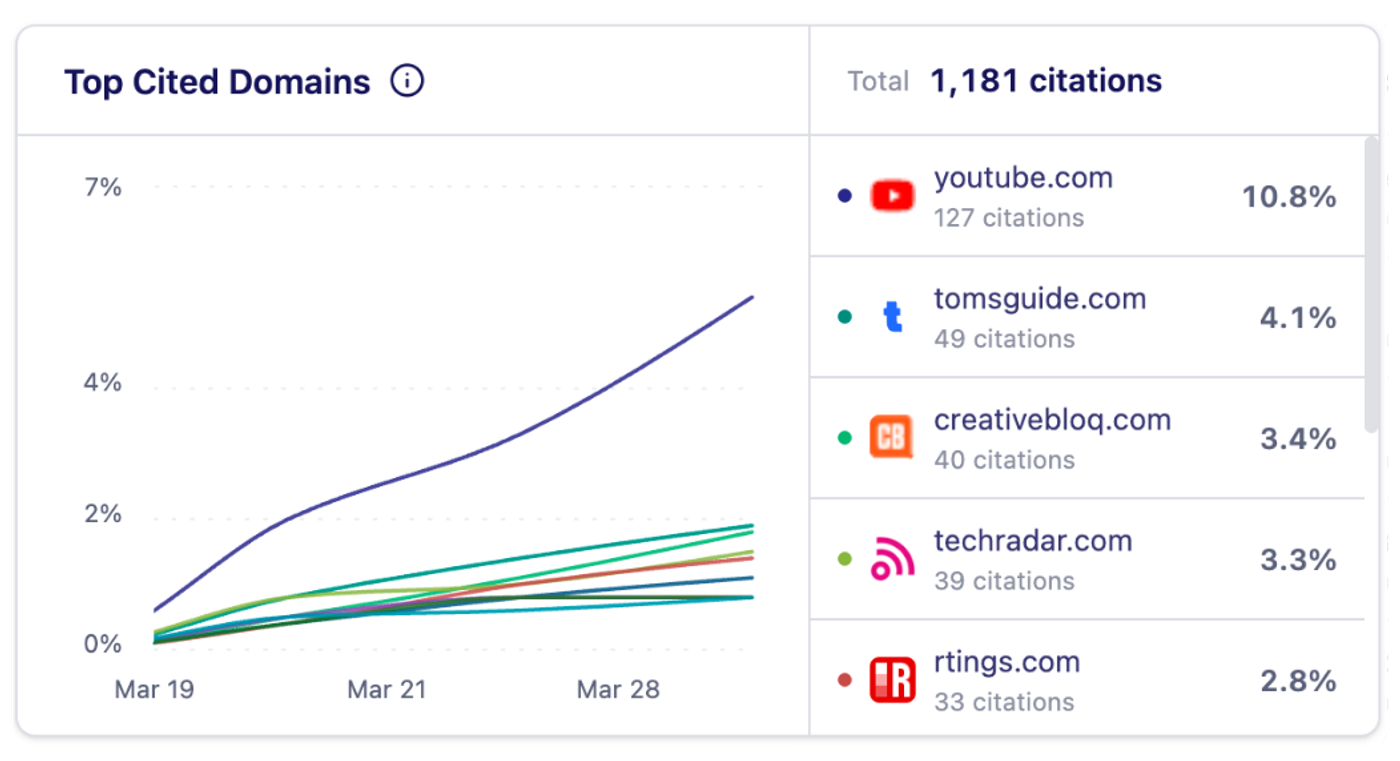
Audit what sources are driving your citations. The source audit feature shows which third-party sources are being cited in AI responses for your category queries, and which sources your competitors are benefiting from that you're not. That tells you exactly where to focus your off-site citation building.
Monitor competitive share of voice. Upsearch tracks not just your own visibility but your competitors', so you can see when a rival starts gaining ground in your category queries before it shows up in your pipeline.
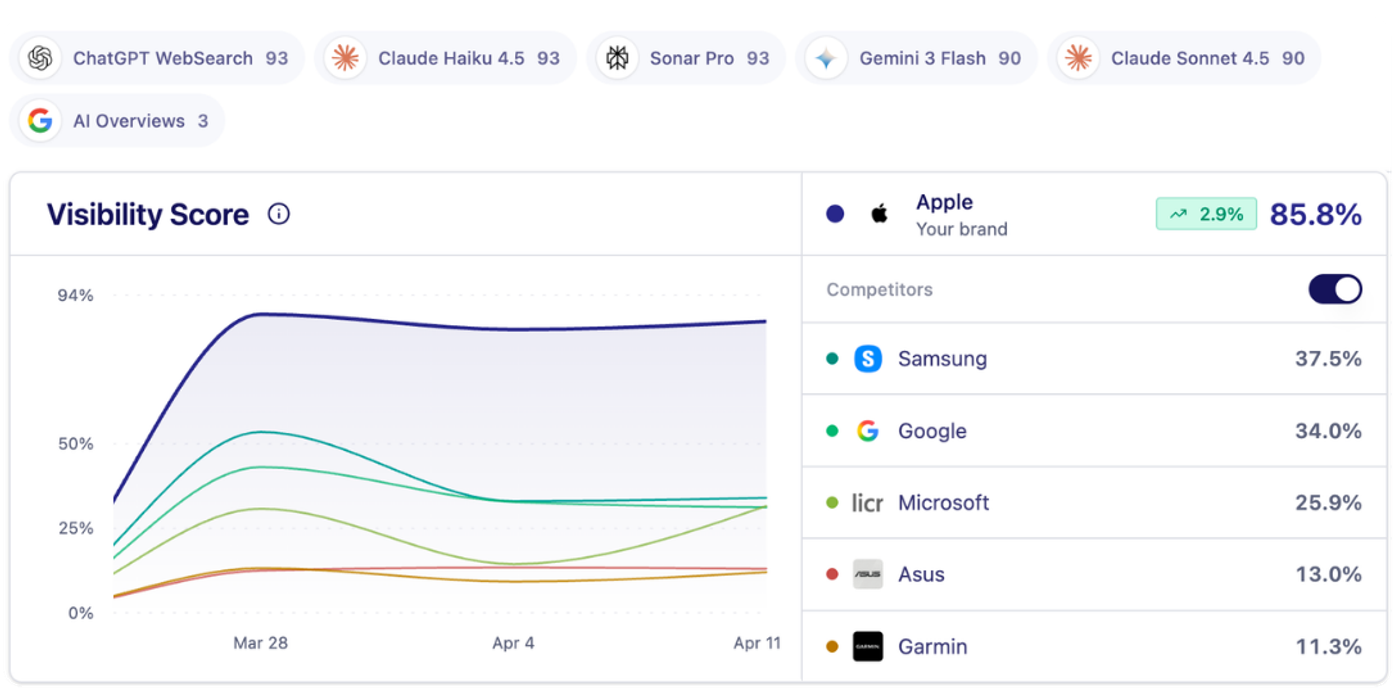
Close the loop between content actions and results. When you publish a new benchmark report or update your G2 profile, Upsearch shows you whether your citation rates move as a result. That feedback loop is what turns GEO from a set of tactics into a repeatable, improvable discipline.
Only 23% of marketers currently invest in GEO measurement . The brands tracking and iterating on their AI visibility now are building a compounding advantage over the ones that aren't.
Real example of GEO use
Here's a concrete example of what the GEO process looks like when you run it through Upsearch.
A B2B SaaS company runs their baseline visibility scan and finds they appear in 8% of relevant category queries across ChatGPT and Perplexity. Their competitors appear in 40-60% of the same queries.
The source audit shows that competitors are being cited primarily through detailed G2 profiles, a widely-cited industry benchmark report they published, and several comparison articles on third-party sites. The company has a thin G2 profile and no original research.
The content action plan becomes specific: update the G2 profile with detailed, structured information about use cases and differentiators. Commission a benchmark report on a topic where they have proprietary data. Reach out to the authors of three comparison articles where they're either missing or misrepresented.
Three months later, Upsearch shows their mention rate has climbed to 22%. The source audit shows the benchmark report is being cited in Perplexity responses. The work is measurable, and the next action is clear.
That's what GEO looks like when it's running as a real channel rather than I need to do something so my boss or my client knows we're kind of on it.
Where to start
If you're new to GEO, the first move is a baseline. Before optimizing anything, you need to know where you currently stand in AI responses.
Search for your category in ChatGPT, Perplexity, and Google without using your brand name. Look at what comes back. If you only appear when the buyer already knows who you are, you have a discovery gap.
Then set up Upsearch to run that query set automatically, so you have a consistent baseline to measure against. Every GEO action you take after that becomes measurable.
63% of companies that have optimized for GEO report an increase in visibility, and GEO techniques improve AI citation rates by 40% on average . The tactics are documented. The measurement tools exist. The gap between the brands doing this and the brands not doing it is still closeable, but the window is narrowing fast.
Upsearch tracks your AI visibility across ChatGPT, Perplexity, Google AI Overviews, and more, giving you the citation data, source audit, and competitive benchmarks to run GEO as an actual discipline. [Start your free visibility scan here.]
Newsletter
Get the next AI search signal in your inbox.
Short, useful updates on AI visibility, citations, prompts, and category positioning.
No spam, unsubscribe anytime. See our privacy policy.
Related reading
Masterclass in AI search
A video-based guide to advanced AI search optimization concepts.
The New SEO You Can't Afford to Ignore
The era of the blue link is giving way to the age of AI synthesis. Discover the architectural foundations of generative engine optimization and learn how to optimize your business for ChatGPT, Claude, and Gemini with Upsearch.
The Metric That Will Define Marketing in 2026
In 2026, blue search links are taking a backseat to generative engine answers. Here is how advanced AI brand visibility tracking helps your business dominate the conversational web without relying on short-lived hacks.
From insight to execution
Track how AI engines actually describe your brand.
Upsearch helps teams monitor prompt visibility, competitive positioning, and citations across the answer engines that now shape real buying journeys.