On this page
- The difference in AI brand tracking between B2B and B2C
- Step 1: Define your tracking queries in Upsearch
- Step 2: Run your baseline visibility scan
- Step 3: Read your visibility scores
- Step 4: Use Upsearch to audit your citation sources
- Step 5: Build your content and citation plan from the gaps
- Step 6: Track changes over time
- What to do with the data beyond marketing
- The metric most teams overlook
73% of B2B buyers now use AI tools like ChatGPT and Perplexity in their purchase research process. That number is from a March 2026 analysis of 680 million citations. If you're a B2B marketer and you're not tracking what those AI tools say about your brand, I'm gonna save your career.
The good thing is only 22% of marketers currently track AI visibility and traffic, and only 25.7% plan to develop content specifically for AI citations. That gap between buyer behavior and marketer response is exactly why AI brand tracking is one of the highest-leverage things a B2B team can do right now and where if leveraged right you can ask for a promotion or increase your fees if you are an agency.
The difference in AI brand tracking between B2B and B2C
B2B buyers are doing longer, more research-intensive due diligence before they ever contact a vendor. Forrester's 2025 survey of 4,000+ buyers found 61% of the buying journey completes before the buyer contacts a vendor, a figure that increases when AI tools provide synthesized comparisons that previously required multiple site visits.
The part of the journey where your brand either makes the shortlist or doesn't is happening in ChatGPT, Perplexity, and Google AI Overviews. In a conversation the buyer is having with an AI and there you have to ask if you're spending an equal budget on AI Search as much as you do with SEO and other channels.
The 2X AI Visibility Index found that 96% of B2B companies are invisible in non-branded AI queries . They only appear when a buyer already knows their name. In the non-branded queries where new demand actually forms, they are absent.
And the stakes of being visible versus invisible aren't abstract. AI search traffic converts at 14.2% compared to Google organic's 2.8%, a 5.1x advantage . The buyers arriving from AI recommendations are further along in their thinking, pre-qualified by the AI's synthesis process before they ever land on your site.
AI brand tracking is how you find out where you stand and what to fix.
Step 1: Define your tracking queries in Upsearch
Before you can track anything, you need a focused set of queries that represent how your buyers actually search in AI tools. Don't think of them as keywords but more like conversational questions.
When you set up your brand in Upsearch, this is the first thing you configure: the query set that your AI visibility will be measured against. Think in four categories:
Category queries: "What's the best [your category] tool for [use case]?" These are the awareness-stage queries where new buyers are forming their shortlists.
Comparison queries: "How does [your brand] compare to [competitor]?" This is where buyers are narrowing down.
Problem queries:"How do I [solve a problem your product solves]?" These pull in buyers who haven't named the category yet.
Validation queries: "Is [your brand] reliable / worth it / good for [specific use case]?"
You can also have Upsearch generate these prompts for you.
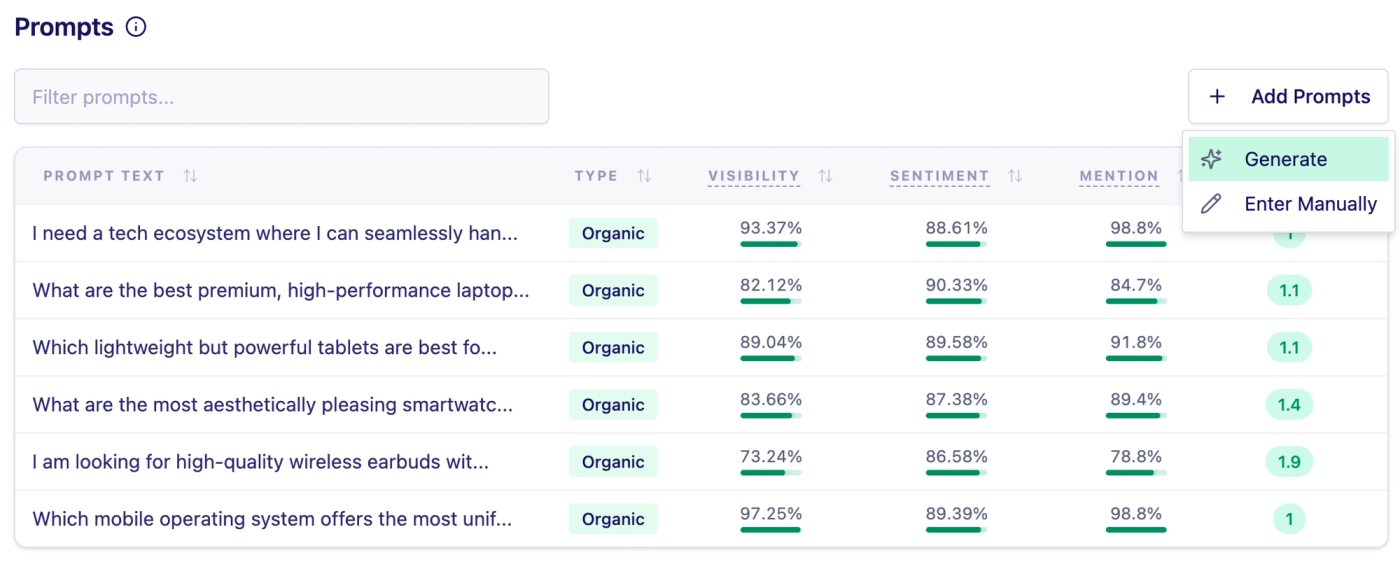
Start with 5-10 queries, depending on the amount of ressources you have. Use your sales call notes, lost deal surveys, and the questions your team gets at events. If you're not sure what buyers are asking, Upsearch's query suggestion tool generates them based on your category and competitors.
Step 2: Run your baseline visibility scan
Once your query set is live in Upsearch, the platform runs each query automatically across the AI platforms that matter for B2B: ChatGPT, Perplexity, Google AI Overviews, and Microsoft Copilot.
This baseline scan is your starting point. For each query and platform, Upsearch captures:
- Whether your brand is mentioned
- Where in the response (first recommendation, part of a list, buried in a footnote)
- How your brand is described
- Which competitors appear
- Which sources are cited
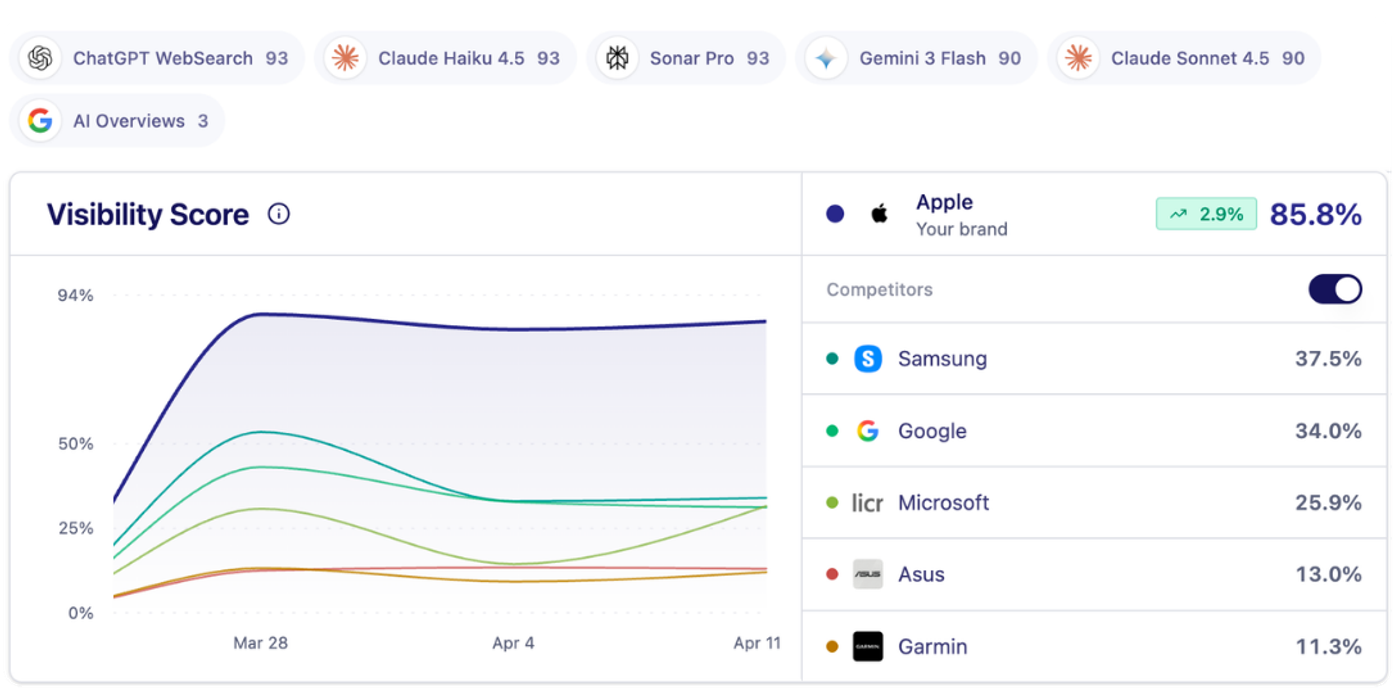
One thing that makes this interesting: citation volumes for the same brand can differ by 615x between platforms, and only 11% of domains are cited by both ChatGPT and Perplexity . So you cannot optimise the same for all platforms as your visibility isn't uniform. A brand that shows up consistently in Perplexity can be completely absent from ChatGPT. Upsearch breaks this down by platform so you're not averaging across channels that behave completely differently.
ChatGPT treats most commercial queries as requiring comprehensive brand options, prioritizing helpfulness through extensive listings. Google AI Overview intentionally minimizes commercial content, relying on organic results for transactions while using AI for educational guidance. Perplexity balances brand mentions with extensive source citations, appealing to research-oriented users who value transparency. Knowing which platform you're underperforming on tells you something specific about the type of content or source coverage you're missing.
Step 3: Read your visibility scores
Upsearch translates the raw scan data into three scores that track over time:
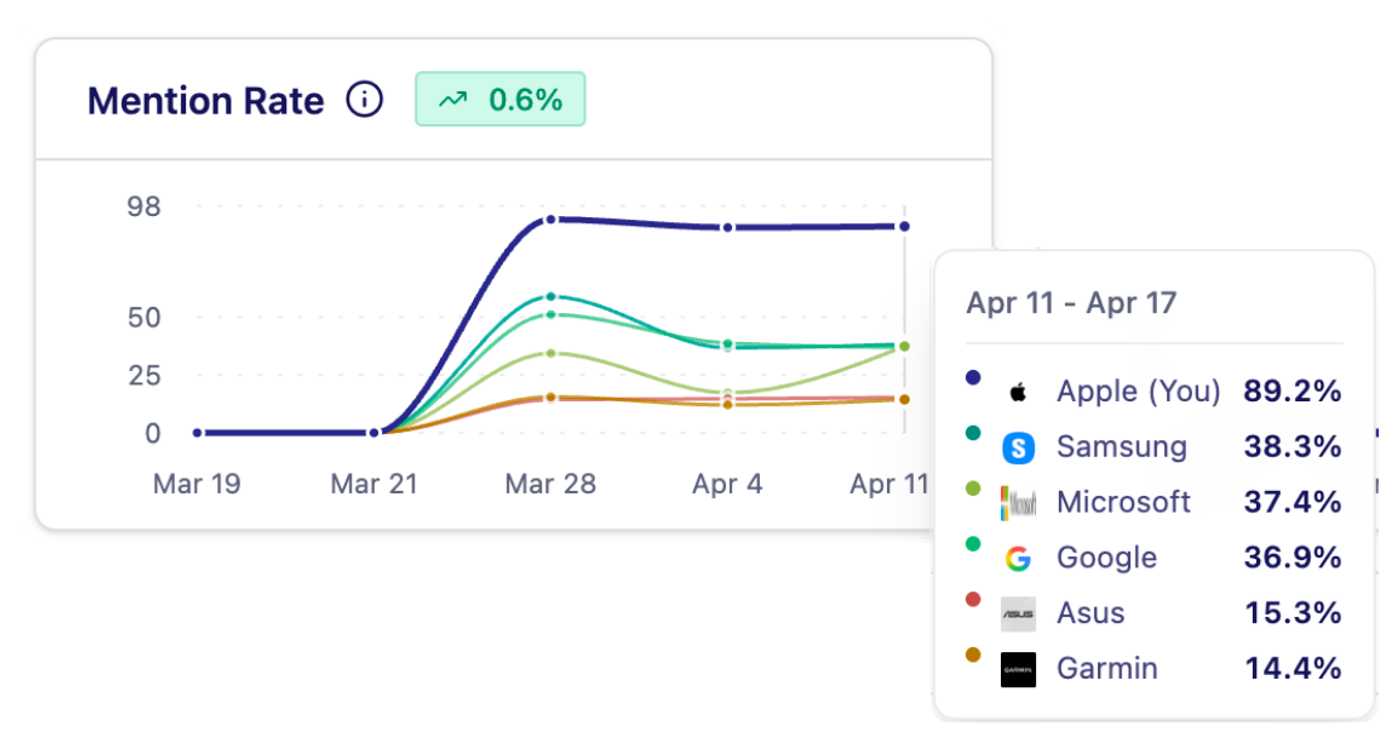
Mention rate: the percentage of relevant queries where your brand appears at all. This is your floor. If it's under 20%, you have a discovery problem.
Position score: where in the AI response you appear. First mention versus fifth mention isn't a small difference. Buyers read AI responses like they read search results: top to bottom, then stop.
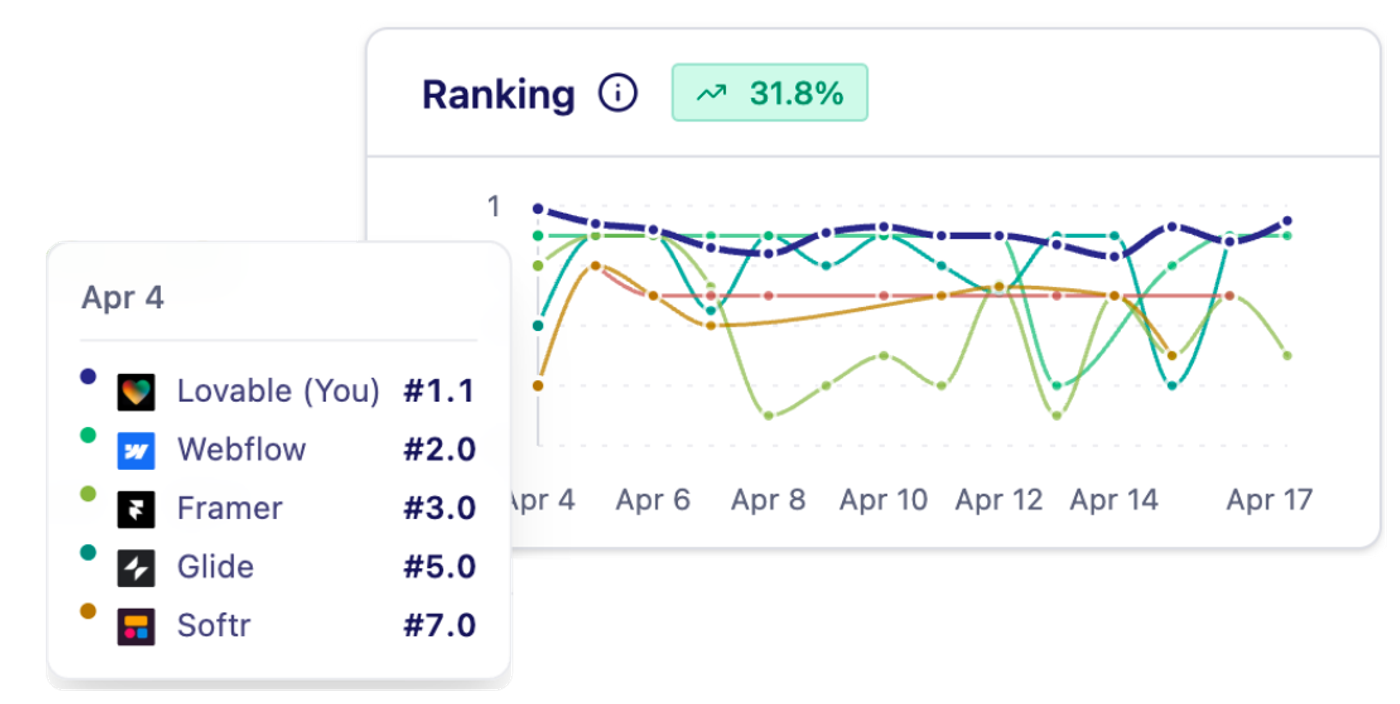
The dashboard also tracks share of voice against your top three competitors. If a competitor consistently appears in the category queries where you don't, that's not a coincidence. It's a content and citation gap you can close.
Step 4: Use Upsearch to audit your citation sources
Scores are useful. What's more useful is knowing why those scores are what they are.
The strongest single predictor of whether a brand appears in AI answers is brand mention frequency across authoritative web sources, which correlates at 0.664 with AI citation rates, approximately three times stronger than backlinks at 0.218. Traditional SEO ranking factors explain only 4-7% of AI citation outcomes.
In other words: Google rankings don't translate. The Walker Sands benchmark analyzed 45 million keywords across 828 enterprise B2B companies and found that AI Overviews now appear in nearly 50% of search results where these companies rank, yet the median enterprise B2B brand is cited in just 3% of the AI-generated answers it is relevant for.
Upsearch's source audit feature shows you which external sources are being cited in AI responses for your category queries. For each query where you appear, you can see the source. For each query where you don't, you can see what's being cited instead.
Common patterns that show up:
- G2 and Capterra profiles for your category are being cited, but yours is thin or outdated
- Industry directories list your competitors but not you
- A competitor has a category-defining piece of content that keeps getting cited as the reference
- Review platforms that Perplexity favors heavily are ones you've ignored
This is the diagnostic layer that turns a score into an action list.
Step 5: Build your content and citation plan from the gaps
Once you know what's missing, Upsearch helps you prioritize what to do first. The platform ranks your gap categories by estimated impact on visibility, so you're not guessing at what to fix.
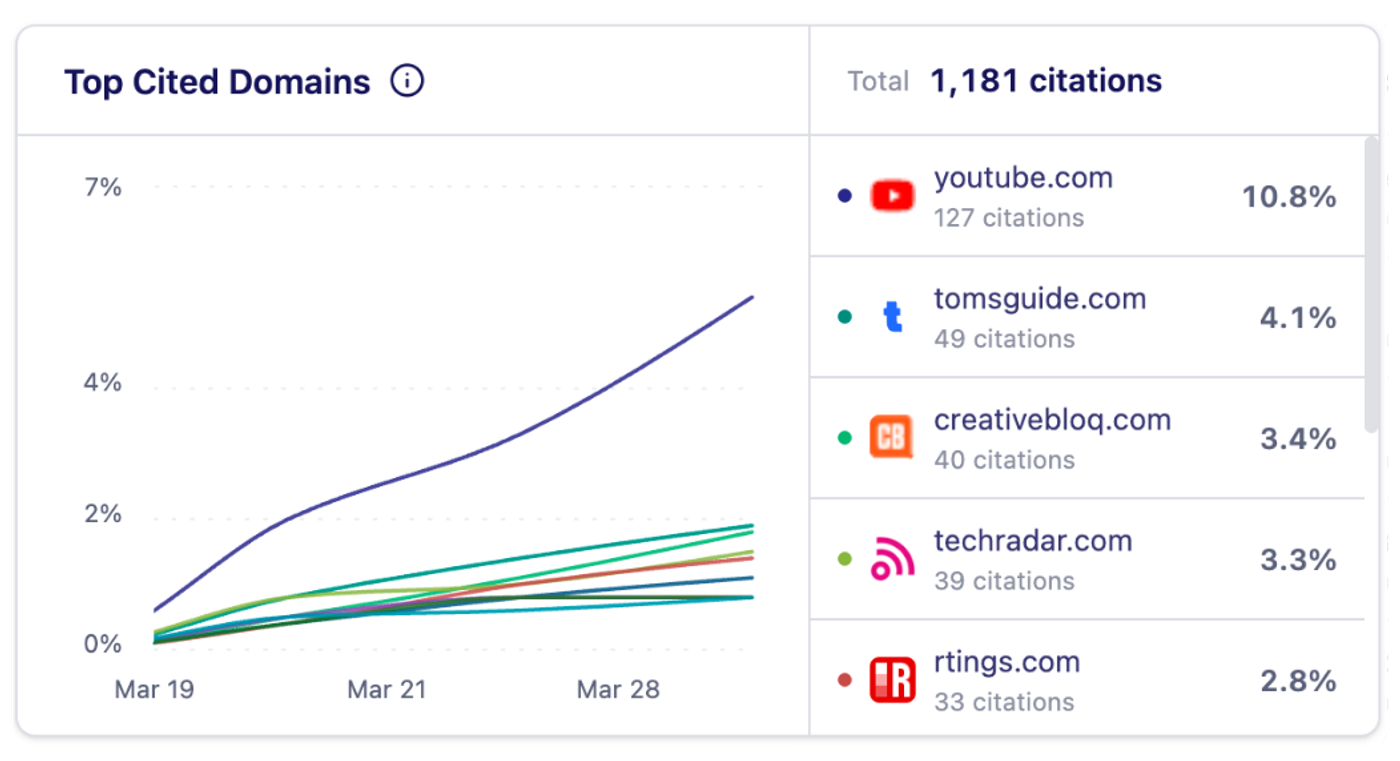
The content types that drive AI citation in B2B are fairly consistent across the research:
Original data and benchmarks: AI models cite statistics heavily. If you publish proprietary research with a distinctive finding, it becomes a citation anchor across multiple platforms for months or years.
Category-level definition content: When buyers ask "What is [category]?", the models need a source. If you own the clearest definition of your category on the web, you anchor brand mentions across every awareness-stage query in that category.
Third-party validation: G2, Capterra, Trustpilot. Analyst mentions. Press coverage. Brands with strong multi-platform presence achieve substantially higher AI visibility than those focusing exclusively on owned websites.
Comparison content: "X vs Y" pages on your own site, and mentions in neutral third-party comparisons. Models construct comparison query responses directly from these.
For each gap in your Upsearch audit, there's a clear content action. Low mention rate on category queries? Your category-level content needs to be stronger and better cited. Appearing with wrong description? Your own site and review profiles need to be updated with the correct positioning, consistently. Missing from specific platforms? Check which source types those platforms favor in Upsearch's platform breakdown and make sure you have presence there.
Step 6: Track changes over time
The Upsearch dashboard runs your query set on a scheduled cadence, so you're not doing manual point-in-time snapshots. You see how your visibility scores move week over week and month over month.
This matters because changes in AI visibility are early warning signals. A competitor appearing in responses where you used to show up. Your accuracy score dropping after a product relaunch. A new AI platform starting to gain traction in your buyer base that you haven't tracked yet.
Upsearch sends alerts when significant changes happen: a new competitor appearing in your top queries, a drop in your position score, or your brand description shifting in a way that diverges from your positioning. You can also set up competitor monitoring, so you're not just measuring your own performance but watching what's moving across your category.
The monitoring also tells you when your content actions are working. If you published a benchmark report in January and your Perplexity mention rate climbs in February, you can see that correlation in the dashboard. That feedback loop makes it possible to treat AI visibility as an actual channel you're optimizing, not a mystery you occasionally check on.
What to do with the data beyond marketing
AI brand tracking data doesn't just inform your content calendar. It feeds several other functions if you share it:
Sales: If Upsearch shows that ChatGPT describes your product as being built for enterprise clients when you primarily serve mid-market, your sales team needs to know. That misperception is showing up in discovery calls. Better to address it head-on.
Product: What questions buyers are asking AI about your category shows you what problems the market is actively trying to solve. That's product intelligence.
Competitive strategy: Watching which competitors are gaining AI visibility in your category before they gain market share is early signal. A competitor that's investing in AI citation coverage today is building an asset that will compound over 12-18 months.
The metric most teams overlook
Most teams start AI brand tracking, see they appear somewhere, and move on. The ones who get real traction stay specific: which query, which platform, what position, what description, what changed since last month.
Companies investing in earned media presence today are building the training signal that will influence ChatGPT's recommendations in six to eighteen months. Companies waiting to invest in AI visibility are simultaneously falling further behind on the ChatGPT compounding curve.
That compounding is the reason to start now rather than when it feels more urgent. The gap between brands that appear in AI responses and brands that don't isn't closing. It's widening, and it's widening faster on the B2B side where the research journey is longer and AI assistance is more deeply embedded in how buyers work.
AI brand tracking is how you stop guessing about where your brand stands in that new buyer journey and start knowing.
-------------------
Upsearch tracks your AI visibility across ChatGPT, Perplexity, Google AI Overviews, and more, giving you the scores, source audit, and competitive intel to act on what you find.
Newsletter
Get the next AI search signal in your inbox.
Short, useful updates on AI visibility, citations, prompts, and category positioning.
No spam, unsubscribe anytime. See our privacy policy.
Related reading
Masterclass in AI search
A video-based guide to advanced AI search optimization concepts.
The New SEO You Can't Afford to Ignore
The era of the blue link is giving way to the age of AI synthesis. Discover the architectural foundations of generative engine optimization and learn how to optimize your business for ChatGPT, Claude, and Gemini with Upsearch.
The Metric That Will Define Marketing in 2026
In 2026, blue search links are taking a backseat to generative engine answers. Here is how advanced AI brand visibility tracking helps your business dominate the conversational web without relying on short-lived hacks.
From insight to execution
Track how AI engines actually describe your brand.
Upsearch helps teams monitor prompt visibility, competitive positioning, and citations across the answer engines that now shape real buying journeys.