On this page
GEO Marketing: How Generative Engine Optimization Is Changing Brand Strategy
The "Search" button is starting to feel like a relic.
Think about your own habits. A few years ago, if you wanted to know how to scale a SaaS brand, you’d type a query into Google, click three different links, and piece the answer together yourself. Today? You likely ask an AI. Whether it’s Perplexity, Gemini, or ChatGPT’s Search, we are moving from a world of links to a world of answers.
For brands, this shift is seismic. It’s no longer just about being #1 on a results page; it’s about being the brand the AI cites as the definitive expert. This is the era of GEO (Generative Engine Optimization), and if your strategy hasn't pivoted yet, you’re essentially invisible to the next generation of consumers.
The Death of the Blue Link?
Traditional SEO taught us to optimize for algorithms that rank pages. GEO, however, requires us to optimize for LLMs (Large Language Models) that summarize concepts. When an AI "recommends" a brand, it’s looking for authority, sentiment, and clear data points.
As an AI search optimisation agency, we’ve seen that the "old ways", keyword stuffing and backlink farming, don't just fail in GEO; they can actually hurt you. Generative engines prioritize context. They want to know why your brand is the solution, not just that you mentioned a keyword ten times.
How GEO Rewrites the Playbook
If you’re looking to maintain your Google visibility in 2026, you have to treat AI engines like digital word-of-mouth. Here’s how the strategy is shifting:
- From Keywords to Conversations: AI engines look for natural language. Your content needs to answer the "hidden" questions your customers are asking.
- Citations are the New Backlinks: Getting mentioned in a synthesized AI answer is the ultimate goal. This requires high-quality, authoritative data that AI models find "trustworthy."
- The Rise of Brand Sentiment: AI doesn't just read your site; it reads reviews, forums, and social mentions to gauge if you’re actually good at what you do.
Pro Tip: Upsearch specializes in bridging this gap. We don't just optimize for bots; we optimize for the logic behind the AI. Explore our AI Search Optimization services to see how we handle this transition.
Why Your Current Strategy Might Be Failing
Most brands are still playing a game where the rules changed overnight. If your content feels like it was written for a robot in 2015, an AI in 2026 will simply ignore it.
To win in the GEO landscape, you need a partner that understands the technical nuances of LLM crawling. Working with an AI search optimisation agency ensures that your brand’s "digital footprint" is formatted specifically for generative synthesis. It’s about making your data easy for an AI to digest, verify, and repeat.
Caption: The shift toward generative answers is reshaping how users discover brands online.
Building for the Future
The goal isn’t to "trick" the AI. The goal is to be so relevant that the AI can’t help but mention you. By focusing on GEO Marketing, you are future-proofing your brand against the decline of traditional search volume.
At Upsearch , we help brands navigate this new frontier. Whether you are curious about content strategy or need a full technical audit , the time to adapt is now.
The search bar is evolving. Are you staying ahead of it, or waiting for the results to disappear?
Newsletter
Get the next AI search signal in your inbox.
Short, useful updates on AI visibility, citations, prompts, and category positioning.
No spam, unsubscribe anytime. See our privacy policy.
Related reading
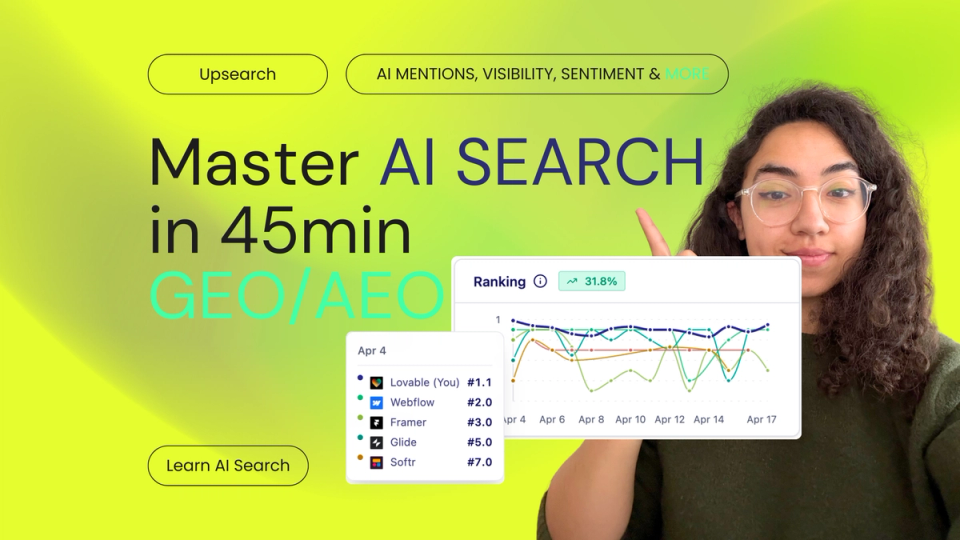
Masterclass in AI search
A video-based guide to advanced AI search optimization concepts.
The New SEO You Can't Afford to Ignore
The era of the blue link is giving way to the age of AI synthesis. Discover the architectural foundations of generative engine optimization and learn how to optimize your business for ChatGPT, Claude, and Gemini with Upsearch.
The Metric That Will Define Marketing in 2026
In 2026, blue search links are taking a backseat to generative engine answers. Here is how advanced AI brand visibility tracking helps your business dominate the conversational web without relying on short-lived hacks.
From insight to execution
Track how AI engines actually describe your brand.
Upsearch helps teams monitor prompt visibility, competitive positioning, and citations across the answer engines that now shape real buying journeys.