On this page
- The Best AEO Tools to Track Brand Mentions in ChatGPT (2026 Guide)
- What Is AEO and Why Does It Matter in 2026?
- What to Look for in an AEO Tool
- The Best AEO Tools to Track Brand Mentions in ChatGPT
- How to Set Up Brand Mention Tracking in ChatGPT
- What Actually Influences Your Brand Mentions in ChatGPT?
The Best AEO Tools to Track Brand Mentions in ChatGPT (2026 Guide)
Here's something that's become obvious if you work in marketing: the way people find products has changed and most teams haven't caught up yet.
A decent chunk of product discovery in 2026 now starts with an AI assistant. Not a Google search. Someone opens ChatGPT, describes what they need, and gets a short list of recommendations. Maybe two or three tool names. Done. They go check those tools and don't come back.
If your brand isn't in that list, you weren't considered. Not ranked lower, not considered at all.
That's what makes tracking brand mentions in ChatGPT worth paying attention to. And it's what AEO tools are actually for not in some abstract future-of-search way, but right now, in conversations happening millions of times a day.
What Is AEO and Why Does It Matter in 2026?
Answer Engine Optimisation (AEO) is the practice of getting your content cited, referenced, or recommended by AI-powered answer engines, ChatGPT, Perplexity, Gemini, and others.
Old SEO logic: show up in a ranked list of links, hope someone clicks. AEO logic: be the answer they get when they stop searching.
The gap matters because buyer behaviour is shifting. When someone asks ChatGPT "which analytics platform works with Shopify?" or "what's the best project management tool for a remote team?", they're not getting ten blue links — they're getting a paragraph with specific brand names. That paragraph is doing a lot of work.
Most marketers still have no real way to know whether their brand is in those paragraphs or not. That's the gap AEO tools are closing.
What to Look for in an AEO Tool
A quick note before the list: a lot of tools claim to do AI search monitoring but are really just rebranded social listening or web mention trackers. The difference shows up pretty quickly once you actually use them.
What you're actually looking for:
- Prompt simulation at scale. Can it run hundreds of queries automatically, the kind your real customers would type, and check whether your brand appears? Manual testing doesn't scale.
- Share of voice data. Not just "did you appear" but "how often, compared to who?" Visibility without competitive context is hard to act on.
- Sentiment tracking. A mention that says "X is overpriced and clunky" is worse than no mention. You need to know the tone, not just the presence.
- Coverage across multiple engines. ChatGPT, Perplexity, Gemini, Copilot, Claude, buyer behaviour is split across all of them. Tools that only track one engine give you a partial picture.
- Trend data over time. A one-time snapshot isn't useful. You need to know whether you're improving.
The Best AEO Tools to Track Brand Mentions in ChatGPT
1. Upsearch
Upsearch was built specifically for this problem, not adapted from something else. It runs prompts across ChatGPT, Claude, Gemini, Perplexity, and Microsoft Copilot, then tracks how often your brand surfaces, where in the response it appears, and how competitors are being positioned relative to you.
What makes it different from broader monitoring tools is the depth. You get citation source analysis (so you can see which third-party pages are actually driving your mentions), sentiment scorecards, and monthly GEO strategy reports that prioritise specific actions rather than just handing you raw data.
There's also a marketing persona feature, you can simulate how different customer profiles search for your category, which turns out to be more useful than it sounds. The queries a senior enterprise buyer runs look very different from the ones a startup founder types.
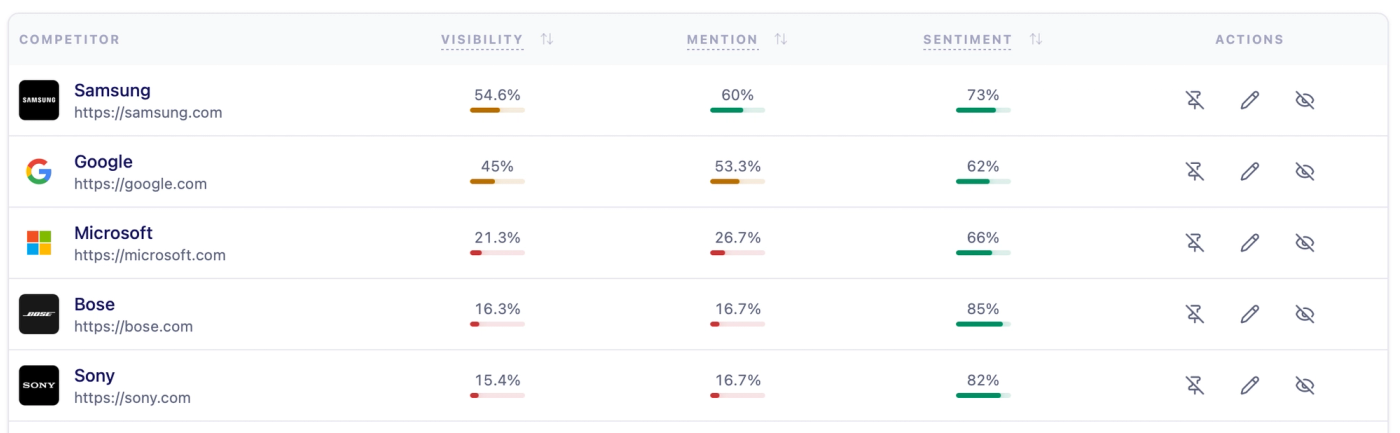
Upsearch competitor table: compare your AI search share of voice against rivals across all major engines
Plans start at €49/month with a free trial. Agency teams get unlimited brands and prompts at €99/month. Try Upsearch free Try Upsearch free →
2. Brandwatch
A well-established monitoring platform that's added AI-generated content tracking to its suite. If your team already uses Brandwatch for social listening and web monitoring, the AI layer is a reasonable extension. It's not built ground-up for AEO, though which shows in the specificity of the data. Better as a complement than a standalone AEO solution.
3. Mention
A cleaner, more accessible option for smaller teams. Good for general brand monitoring; the AI search coverage exists but isn't deep. Worth considering if budget is a constraint and you're just starting to explore the space.
4. Semrush (AI Overview Tracking)
Semrush added AI Overview visibility tracking when Google's AI Overviews rolled out. This is specifically Google's AI layer, not ChatGPT so the use case is slightly different. For teams already running their SEO in Semrush, it adds useful context. Just don't confuse it for broader AI search tracking.
Further reading: Search Engine Land covers ongoing developments in AI search and AEO strategy.
How to Set Up Brand Mention Tracking in ChatGPT
If you're starting from scratch, manual testing is a reasonable first step not a long-term solution, but it gives you a real baseline before you invest in tooling.
Start by writing out 20–30 prompts your ideal customer would actually type. Not your brand name, queries like "best tool for managing customer onboarding" or "what CRM works for a 10-person team." Run them in ChatGPT, Perplexity, and Gemini and log what comes back: does your brand appear, where in the response, and who else shows up?
- Set a cadence. Weekly is realistic if you're using a tool; monthly if you're doing it manually. The landscape shifts a model update can change what gets cited overnight.
- Categorise your prompts. Comparison queries ("X vs Y"), recommendation queries ("best tool for..."), and problem-solving queries each pull different results. You'll probably perform differently across them.
- Close the loop to content. If you're consistently missing from a category of query, that's a content gap not a PR problem. Build the authority content that covers it.
What Actually Influences Your Brand Mentions in ChatGPT?
Honest answer: the exact weighting is opaque. No one outside the model providers really knows. That said, a few things consistently show up as factors:
- Web presence and breadth. ChatGPT's training data is essentially a compressed version of the internet. Brands with a strong, widespread footprint review sites, press, forums, documentation surface more reliably than those with a thin presence, even if the product is better.
- Third-party mentions. Reviews on G2, Capterra, Reddit threads, industry publications, these signal to the model that your brand is real and credible. User-generated content is particularly weighted because it's harder to manufacture.
- Answer-style content. Pages that directly answer questions, FAQs, comparison guides, how-to articles, tend to do better than brochure-style copy. If your website is mostly "we help companies achieve more", that's not what AI models pull from.
- Recency. Tools with live retrieval (Perplexity especially) weight fresh content heavily. A blog post from 2023 works differently than one from last month.
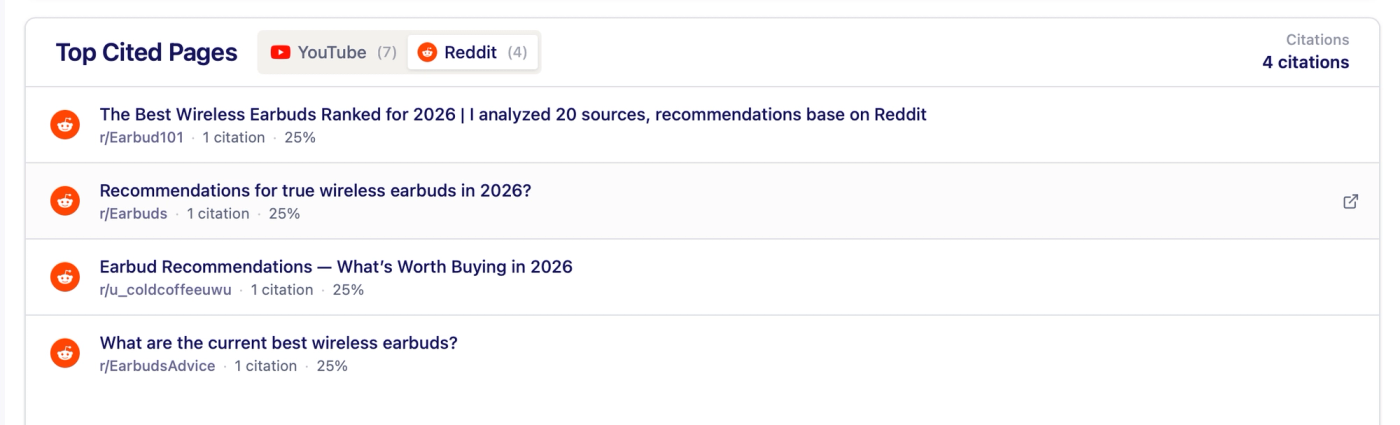
Upsearch citation tracking: see which third-party sources - Reddit, review sites, publications - AI engines site when mentioning brands in your category
Tracking brand mentions in ChatGPT has quietly moved from "interesting experiment" to table stakes for any company that cares about how buyers find them. The tools above cover a range of team sizes and budgets but if you're serious about it, starting with a platform built specifically for AI search visibility will save you a lot of guesswork.
Newsletter
Get the next AI search signal in your inbox.
Short, useful updates on AI visibility, citations, prompts, and category positioning.
No spam, unsubscribe anytime. See our privacy policy.
Related reading
Masterclass in AI search
A video-based guide to advanced AI search optimization concepts.
The New SEO You Can't Afford to Ignore
The era of the blue link is giving way to the age of AI synthesis. Discover the architectural foundations of generative engine optimization and learn how to optimize your business for ChatGPT, Claude, and Gemini with Upsearch.
The Metric That Will Define Marketing in 2026
In 2026, blue search links are taking a backseat to generative engine answers. Here is how advanced AI brand visibility tracking helps your business dominate the conversational web without relying on short-lived hacks.
From insight to execution
Track how AI engines actually describe your brand.
Upsearch helps teams monitor prompt visibility, competitive positioning, and citations across the answer engines that now shape real buying journeys.